Tomb of the Unknown Soldier at Altare della Patria
Learn how Italy's Unknown Soldier was chosen, brought to Rome and buried at the Vittoriano, and how to visit the guarded memorial respectfully.
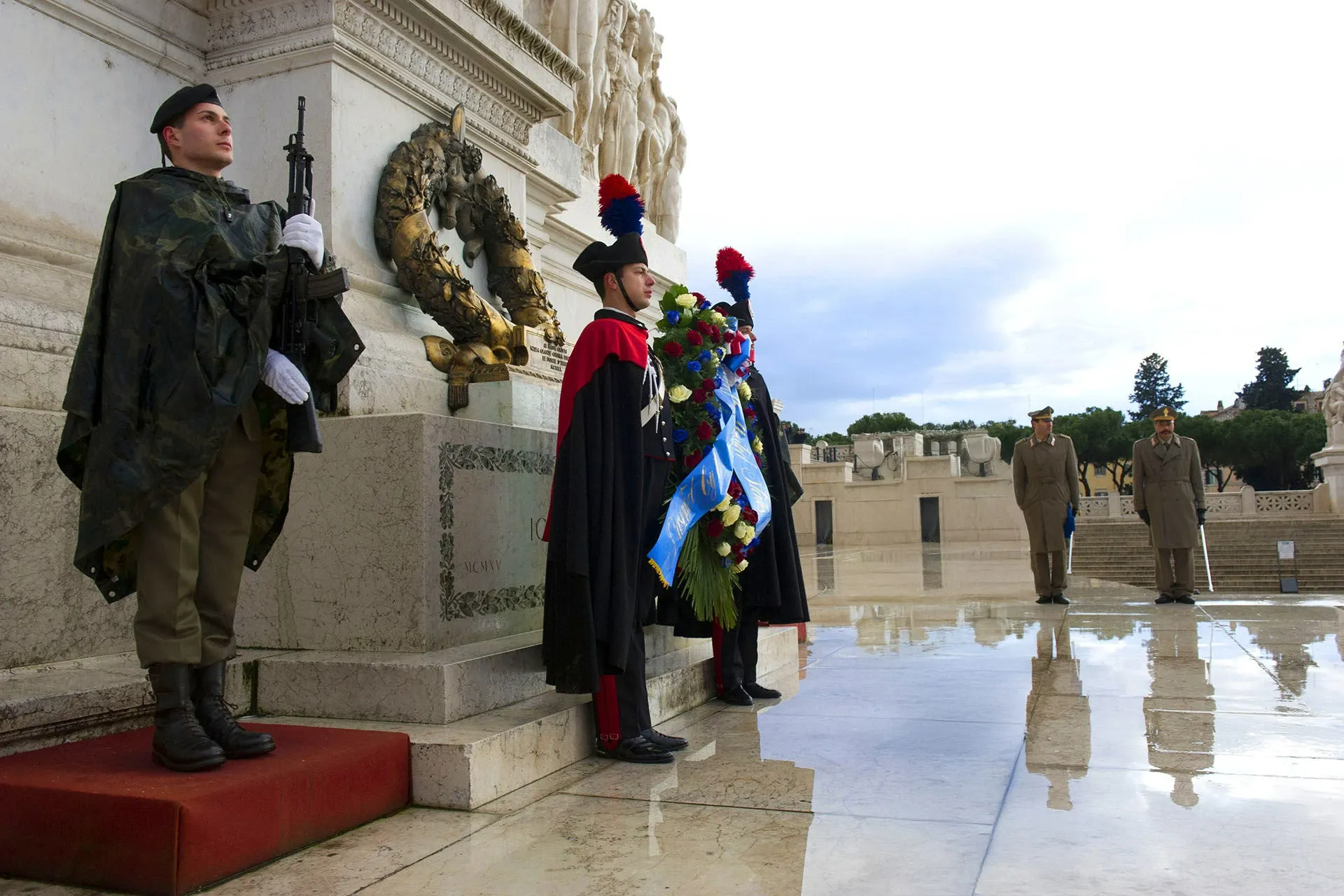
At the centre of the Vittoriano, below the goddess Roma and above the main stairs, lies the remains of an unidentified Italian serviceman. The Tomb of the Unknown Soldier is visually smaller than the king's statue and upper colonnade, but it is the monument's emotional and ceremonial heart.
Why an unknown soldier?
The First World War caused death on a scale that often prevented individual identification. Families could be left without a body or grave. Memorials to an unknown serviceman allowed one anonymous burial to stand for all the missing and fallen, giving private grief a public location.
Italy's choice came after the war, when the country was struggling with loss, political tension and the meaning of victory. The anonymous soldier could represent people from different regions and social backgrounds more broadly than a named commander or ruler.
Selection at Aquileia
Eleven coffins containing unidentified remains from different battle areas were brought to the Basilica of Aquileia. On 28 October 1921, Maria Bergamas, whose son Antonio had died during the war and whose body had not been recovered, was asked to choose one.
Her gesture made maternal mourning central to the national ritual. Accounts describe her moving among the coffins before indicating the chosen one. The precise emotional scene has often been retold with dramatic embellishment; the secure historical point is that a bereaved mother selected the remains on behalf of the country.
The ten unchosen soldiers were buried at Aquileia, where they remain part of the same commemorative story rather than discarded alternatives.
The train to Rome
The chosen coffin departed by special train on 29 October 1921. At stations and along the railway to Rome, large crowds gathered in silence, saluted or placed flowers. The journey transformed distance into ceremony: communities encountered the coffin locally before it reached the capital.
This was an important act in a country unified only decades earlier. The route tied former battle zones and provincial towns to a national destination, while the slow pace allowed mourning to unfold beyond official elites.
Burial on 4 November 1921
The Unknown Soldier was buried at the Vittoriano on 4 November, the anniversary associated with the end of Italy's First World War operations. The Altar of the Fatherland, already a central part of Sacconi's royal monument, became the setting for a new kind of memory.
That addition changed the hierarchy of the building. Victor Emmanuel II remained the named hero above, but an anonymous serviceman now represented sacrifice below. The monument could speak to families who had no connection with royal commemoration.
Eternal flame and honour guard
The tomb is flanked by flames and watched continuously by an honour guard. The guard is not a performance staged primarily for tourists; it is a continuing act of state remembrance.
Major national ceremonies include wreath-laying at the memorial. Routes can close or change when institutional events take place, particularly around significant civic dates.
From eleven unknowns to one national representative
The selection process protected anonymity. Eleven coffins containing unidentified remains from different battle areas were assembled at Aquileia. On 28 October 1921, Maria Bergamas—whose son Antonio had died and whose body was not recovered—chose one. The other ten were buried at Aquileia, preserving that basilica as a second essential site in the story.
The chosen coffin departed by train on 29 October. Crowds gathered along the route, making the passage through Italy as important as the final capital ceremony. The soldier became national not because an identity was discovered, but because communities collectively received an individual who could not be named.
The two faces of the shrine
The exterior tomb is the familiar element visible beneath Roma. An interior sacellum is connected with the soldier's remains and commemoration, while the Shrine of the Flags forms another specialist memorial area. These spaces do not follow the same general admission assumptions as the open terraces. VIVE directs visitors to Ministry of Defence information for current access.
The distinction prevents a common misunderstanding: seeing the exterior tomb does not mean every shrine interior is open. Anyone travelling specifically for military history should verify those arrangements rather than relying on the main monument schedule.
Continuous guard and state ceremony
The honour guard is continuous, not an hourly attraction. Personnel and duties change according to institutional procedure, but visitors should not organize the memorial as if it offered a show on the hour. The steady presence expresses the state's ongoing custody of the unknown dead.
Wreath-laying ceremonies place the tomb at the centre of republican civic life. On significant dates, access can be restricted and security increased. Those changes are evidence of function, not simply inconvenience. The Unknown Soldier remains part of official remembrance rather than a historical display sealed in 1921.
Anonymity, citizenship and interpretation
The tomb was created under the monarchy and later used during Fascism, yet it remains central in the republic. Anonymity makes that continuity possible but not politically neutral. Each period frames sacrifice differently. Current VIVE interpretation situates the memorial within an anti-fascist, democratic and European Italy.
Visitors can acknowledge military sacrifice without turning the monument into a celebration of war. The most responsible reading attends to loss, families without graves and the public institutions that decide how death is remembered.
Why 4 November carries several histories
The burial occurred on 4 November 1921, three years after the armistice associated with the end of fighting for Italy in the First World War. The date later became a national commemorative point connecting unity and the armed forces. At the Vittoriano, that calendar link brings the Risorgimento story, wartime death and present state ceremony into the same space.
Those layers should not be collapsed into one timeless patriotic ritual. The monarchy that organized the burial, the Fascist regime that later used national sacrifice, and the democratic republic that now lays wreaths are different political orders. Continuity of place makes their differences available for study.
The value of a quiet visit
Large ceremonies are visually impressive, but an ordinary day can make the memorial easier to understand. The continuous guard, small movements of visitors and steady flames show remembrance as routine institutional work. Spend a few minutes without photographing. The contrast between the anonymous tomb and the enormous named king above becomes clearer when attention is not directed by an event.
The inner shrine
The visible tomb on the façade is connected with an interior memorial space or sacellum. Access arrangements for the Shrine of the Unknown Soldier and Shrine of the Flags are not the same as the general open-air route; VIVE advises consulting the Ministry of Defence information. Do not assume that entering the exterior monument guarantees access to every commemorative interior.
Visiting respectfully
Approach quietly, stay outside barriers and follow guard instructions. Do not sit on memorial structures or use the tomb as a casual pose backdrop. Photography for personal use is generally allowed at VIVE unless signs prohibit it, but a permitted photograph can still be made discreetly.
The exterior memorial belongs to the currently free section of the Vittoriano. Official hours list the monument daily, but state events and security needs can override ordinary access. Verify current notices before a visit planned specifically around the guard ceremony.
Why the memorial still matters
Italy changed from monarchy to dictatorship and then republic after the tomb was installed. The Unknown Soldier endured as a focus because anonymity allows meaning to extend beyond one regime. Today official interpretation places remembrance within democratic, anti-fascist and European values.
The tomb asks visitors to hold two thoughts together: national history is made through public decisions, and its cost is borne by individual people whose names can disappear. That tension gives this small guarded space its power within the Vittoriano's enormous architecture.
O autorovi

Rome Visitor Guide
Tento nezávislý průvodce vychází z informací VIVE, italského ministerstva kultury a muzeí a pomáhá návštěvníkům rozlišit bezplatný vstup od placených zážitků.
Tags
Comments (0)
Loading comments...