Vittoriano Symbols and Quadrigae Explained
Decode the Vittoriano's Unity and Freedom quadrigae, winged victories, goddess Roma, stars, flames and other national symbols.
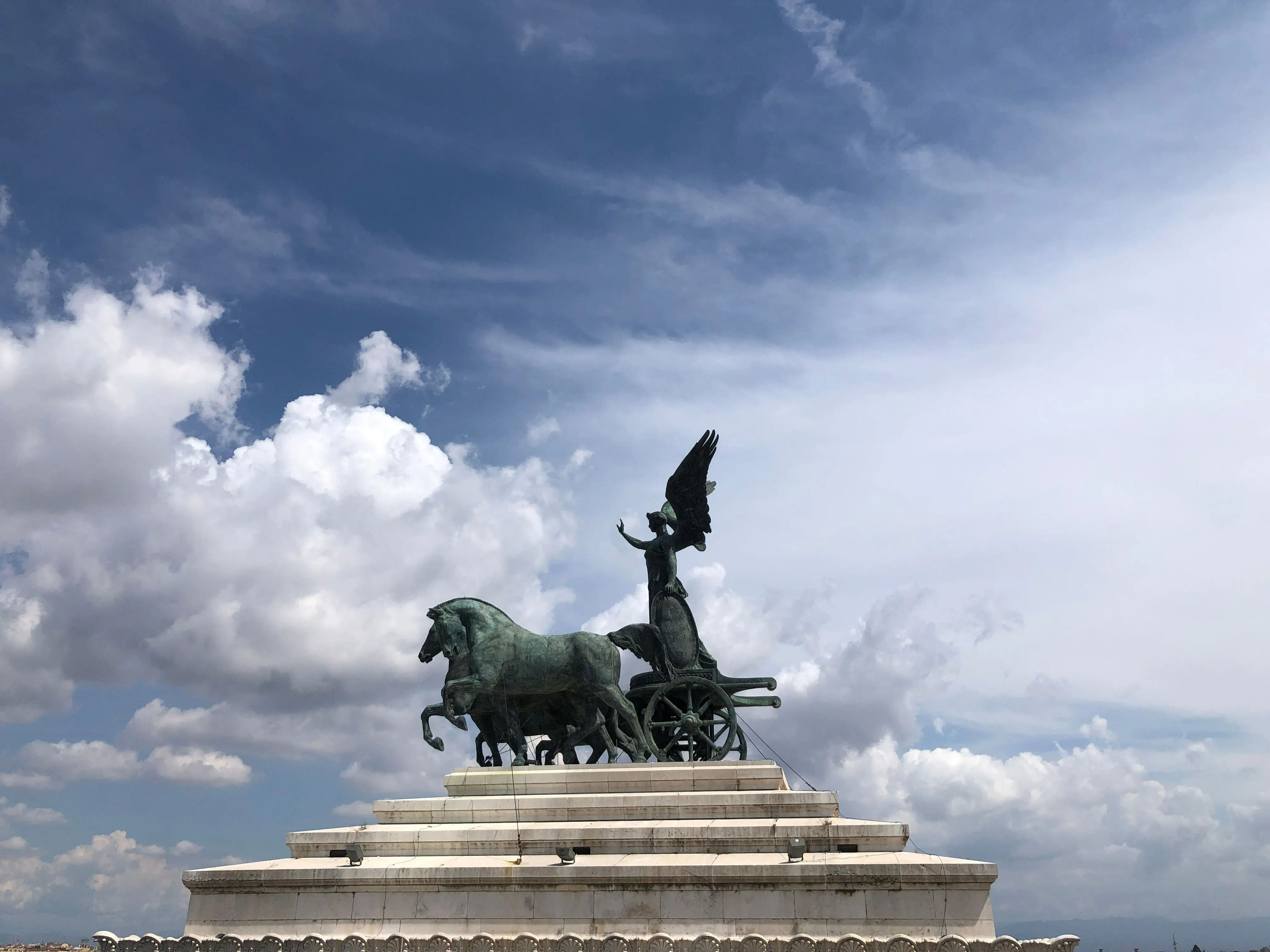
The Vittoriano communicates before a visitor reads a label. Wings suggest victory, chariots suggest public triumph, flames signal unbroken remembrance and an enthroned Roma connects the modern capital to an ancient personification. These symbols were chosen for legibility across a vast façade, but their meanings become more precise when seen in context.
The rooftop quadrigae
Two monumental bronze chariots crown the end pavilions of the upper portico. Carlo Fontana created the quadriga of Unity and Paolo Bartolini the quadriga of Freedom; each is drawn by four horses and guided by a winged Victory. Official sources conflict over assigning the works to compass sides, so identify them by artist and ideal rather than east or west.
From the city they operate as silhouettes. From the Panoramic Terrace, their scale and modelling become clear: horses, wheels, wings and drapery are engineering as well as sculpture, designed to remain expressive against open sky. Their paired placement prevents one concept from standing alone. National unity without freedom would be coercive; freedom without a shared civic structure would fragment the monument's message.
Why the chariot is classical
Quadrigae were associated in antiquity with victory, ceremonial movement and divine or imperial display. Modern European monuments reused the form because it could signify triumph without depicting a specific battle. At the Vittoriano, the ancient visual language grants historical dignity to values claimed by a recently unified state.
The symbolism is selective rather than archaeological. These are modern bronzes serving a modern national project, not reconstructions of Roman vehicles.
Winged Victory throughout the monument
Victory appears repeatedly in bronze and stone, sometimes with a chariot and sometimes as an independent figure. Wings make the personification instantly distinguishable and create dynamic outlines against pale marble. Repetition links lower details with the summit, carrying the eye upward.
Look for changes in pose and scale. Some victories seem to announce achievement; others guard, crown or accompany. Their classical identity was familiar to Sacconi's audience, but the political object of victory had shifted from an ancient ruler to Italian unity and national values.
Roma at the altar
At the centre of Angelo Zanelli's Altar of the Fatherland sits the personification of Roma. She is not a portrait of a historical woman but an embodiment of the city and its authority. Her frontal stillness contrasts with the movement of horses and winged figures above.
Rome's position is both geographic and ideological. The city became capital in 1870, completing the central phase of unification. At the monument, Roma anchors the state in an imagined continuity with antiquity while presiding over the modern memorial below.
Eternal flames and the Unknown Soldier
Two flames burn beside the Tomb of the Unknown Soldier. Unlike allegorical sculpture, these are living ceremonial signs. Their continuity expresses permanent remembrance, while the honour guard makes the state's duty visible through human presence.
The flames are connected with First World War sacrifice, not with the original royal commission. Their addition demonstrates how the monument acquired new symbols as Italian history changed.
The star and the tricolour
The five-pointed Star of Italy has a history older than the republic and appears in Italian national iconography as a personification of the country's destiny and identity. The tricolour flag supplies a more direct modern emblem. Around the memorial, flags and ceremonial display connect carved allegory with the institutions of the present state.
Symbols can survive political change because their interpretations are not fixed forever. The republic inherited forms developed under the monarchy and placed them within constitutional, democratic practice.
The quadrigae as late completions
The rooftop chariots were installed in 1927, sixteen years after the unfinished monument's inauguration. Carlo Fontana created Unity and Paolo Bartolini created Freedom. Their late arrival is a reminder that the symbolic programme was completed in stages rather than unveiled all at once.
The paired ideals are more informative than a compass-side label. Official VIVE material has conflicted over which work occupies which side, so assigning east and west risks repeating an unsupported certainty. Artist, title and visual position within the paired propylaea are sufficient for interpreting them.
The altar's symbols changed context
Angelo Zanelli's Altar of the Fatherland, completed in 1925, places Roma at its centre and extends allegorical reliefs across the façade. Yet the Unknown Soldier had already been entombed there in 1921. Art conceived for a national altar consequently came to frame a specific memorial ritual.
Roma's stillness, the guarded tomb and the living flames now operate together. The sculpted personification supplies historical authority; the anonymous remains supply human loss; the continuous guard supplies present institutional duty. Meaning comes from their combination, not from any one motif in isolation.
Inscriptions, wreaths and ceremonial objects
Wreaths and flags introduced during ceremonies are temporary objects, but they can become the most visible symbols on important dates. Their placement shows that a national monument is continually activated rather than complete once carving stops. The same principle applies to the tricolour displays associated with Republic Day.
Classical motifs such as laurel, winged figures and chariots belong to a shared European vocabulary of honour and victory. They do not prove a secret code. Their significance depends on location, scale and the modern subjects—Unity, Freedom, Roma and remembrance—to which the Vittoriano assigns them.
How scale controls interpretation
From Piazza Venezia, the chariots and victories work as dark signs against the sky. At terrace level, the eternal flames and honour guard dominate attention. At close range, attributes in the value groups become legible. The monument therefore reveals different symbols at different distances.
A useful method is to photograph less and change position more. Identify a form from below, find it again from the terraces, then read its official label. This reduces the temptation to attach an invented meaning to every animal, weapon or fold of drapery.
Symbols also acquire meaning from ceremony. A laurel wreath placed by a state representative, a tricolour display on Republic Day or the continuous presence of guards can temporarily outweigh permanent sculpture. The building's iconography is therefore both fixed and performed. What happens at the altar on a particular date belongs to interpretation just as surely as what Zanelli carved.
Water, seas and geographic symbols
The fountains at the Vittoriano's lower sides represent the Adriatic and Tyrrhenian seas. Water establishes a geographic frame before the visitor encounters cities and regions higher up. This vertical arrangement turns the building into a symbolic peninsula: bounded by seas, articulated by local identities and centred on Rome.
Reading without over-reading
Not every lion, wreath or decorative motif carries a unique secret message. Monumental art uses a shared vocabulary, and repeated forms can serve compositional needs as well as iconography. Begin with symbols confirmed by official interpretation, then observe how their placement affects meaning.
The best route is bottom to top: seas, altar and flame; king and civic figures; regions and portico; Unity and Freedom against the sky. In that order, the Vittoriano reveals itself as a carefully organized visual argument rather than a random accumulation of patriotic ornament.
L'autore

Rome Visitor Guide
Questa guida indipendente utilizza informazioni di VIVE, del Ministero della Cultura e dei musei per distinguere con chiarezza aree gratuite ed esperienze a pagamento.
Tags
Comments (0)
Loading comments...