The Vittoriano's Meaning in Modern Italy
Explore how the Vittoriano moved from royal memorial to a living republican site of remembrance, ceremony and democratic national identity.
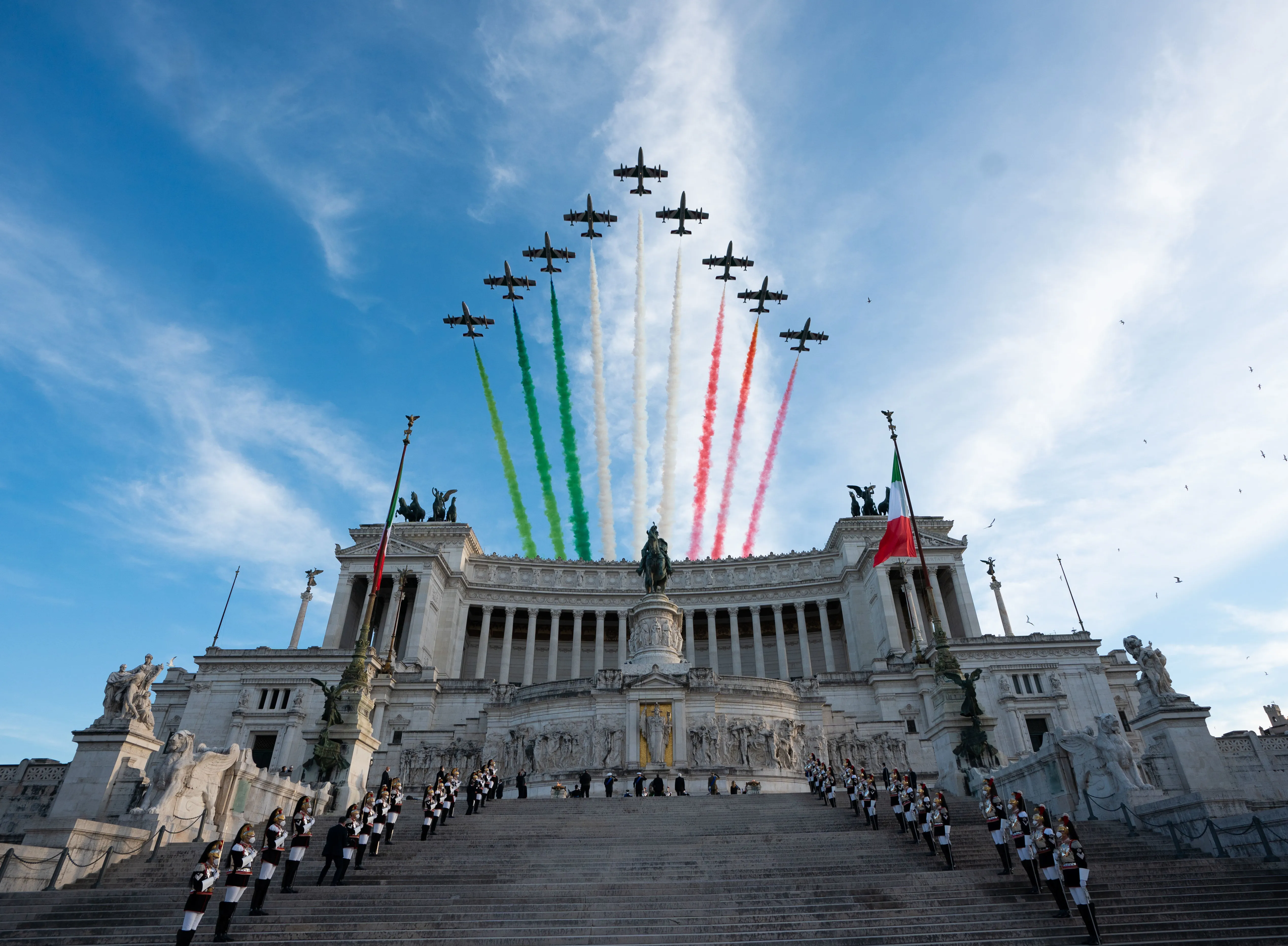
Few monuments change political systems without changing address. The Vittoriano was commissioned by a monarchy, used as a stage during dictatorship and inherited by a republic. Its modern importance lies not in pretending those transitions never happened, but in the way Italians continue to interpret them in public.
A royal foundation
The monument began as a memorial to Victor Emmanuel II, first king of unified Italy. Its nineteenth-century programme celebrated unity through a ruler, regional allegories and civic virtues. Architecture presented the nation as coherent, monumental and connected to Rome's classical prestige.
That message was aspirational. Italy had united politically, but strong regional identities, social inequalities and competing political traditions remained. The building's very abundance of regional and civic personifications reveals how much symbolic work unity required.
The Unknown Soldier creates a shared focus
The burial of the Unknown Soldier in 1921 transformed the Vittoriano more deeply than any decorative addition. An unidentified serviceman could stand for losses across class and region. Maria Bergamas's selection of the coffin at Aquileia and the funeral train's journey to Rome connected local mourning with a national ceremony.
The tomb remains guarded and marked by eternal flames. It is the focal point for wreath-laying by the highest institutions of the state. Visitors encounter a form of memory that is personal in its grief but anonymous in identity, allowing it to represent many families.
The burden of Fascist spectacle
Fascism exploited monumental space and mass ceremony throughout Rome. The Vittoriano's terraces and the proximity of Palazzo Venezia made Piazza Venezia a particularly charged setting. Later viewers often associated the entire ensemble with Mussolini's regime, even though the Vittoriano had been conceived and largely built earlier.
Responsible interpretation keeps both facts in view: the monument is not Fascist in origin, and its public image cannot be separated completely from Fascist appropriation. This is one reason it has generated ambivalence rather than a single stable response.
A monument within the republic
Italy became a republic in 1946, and the 1948 Constitution established a democratic order grounded in anti-fascism. The Vittoriano's inherited symbols had to be reframed. The king's statue remained, but civic practice concentrated on the Unknown Soldier, the flag and ceremonies representing the state rather than a dynasty.
Official VIVE interpretation today describes the monument in relation to an Italy that is anti-fascist, democratic and European. The wording matters: it treats national identity as constitutional and open to historical reflection, not simply as ethnic pride or military glory.
Ceremony and ordinary visiting
On major commemorative dates, state representatives lay wreaths at the tomb. Republic Day on 2 June, Liberation Day on 25 April and National Unity and Armed Forces Day on 4 November place the site within the civic calendar. Routes may change during ceremonies, but the restrictions are evidence that this is a working national memorial rather than a preserved stage set.
On an ordinary day, the continuous honour guard gives visitors a quieter glimpse of institutional continuity. Respectful behaviour matters even when no official delegation is present. The monument combines tourism and mourning, and neither function cancels the other.
Debate as part of significance
Romans have given the building affectionate and critical nicknames based on its colour and shape. Architectural critics have objected to its size, demolition history and contrast with the surrounding city. Others value its craft, museum collections, public terraces and role in national remembrance.
These disagreements are not a failure of the monument. They show that national symbols remain open to argument. A democratic relationship with heritage does not require every citizen to admire the same style or accept an old political message unchanged.
Why the popular nicknames matter
Unofficial comparisons to a “wedding cake” or “typewriter” are often repeated as simple jokes. They reveal something more useful: the Vittoriano's pale Botticino marble and broad silhouette remain visually disruptive in a city associated with warmer materials and accumulated irregularity. A nickname lets residents domesticate an official monument, reducing its solemn claims to everyday scale.
The labels should not be presented as formal names or proof that Romans share one opinion. Some people dislike the architecture; others value its craftsmanship, memorial role and terraces. Public meaning includes both attachment and criticism.
National dates and constitutional memory
The site's modern calendar helps distinguish the republic's use from the intentions of the monarchy or Fascist regime. On 25 April, Italy commemorates liberation from Nazi occupation and Fascism. On 2 June, it marks the 1946 referendum and birth of the republic. On 4 November, ceremonies connect national unity and the armed forces with the Unknown Soldier's 1921 burial.
Wreath-laying at a royal-era monument does not restore royal politics. Instead, contemporary institutions direct inherited architecture toward constitutional remembrance. VIVE's emphasis on an anti-fascist, democratic and European Italy is part of that active reinterpretation.
Tourism changes meaning too
The museum route and panoramic lifts bring visitors for reasons Sacconi could not have predicted. A traveller may arrive for the skyline, encounter the guarded tomb, and only then learn why the building exists. This movement from tourism to historical attention can be productive if the viewpoint does not eclipse the memorial.
The reverse is also true: public access keeps the building from becoming an isolated official stage used only on ceremonial dates. Families, students and international visitors occupy terraces once designed for national spectacle. Their varied presence makes the monument part of ordinary civic life, while rules around the tomb preserve a boundary between recreation and remembrance.
Democratic reuse does not erase difficult history
Reframing is different from forgetting. The king remains in place, the demolition history remains visible in the urban fabric, and Fascist appropriation remains part of Piazza Venezia's twentieth-century associations. Democratic institutions use the monument while interpreting those layers rather than physically rewriting them.
That approach allows criticism inside stewardship. A visitor can object to the scale, political message or losses caused by construction and still value conservation, public access and respectful remembrance. The Vittoriano's modern national meaning lies partly in sustaining that disagreement without reducing the building to propaganda or scenery.
A useful question to carry through the visit
Ask not “What does the Vittoriano symbolize?” as if one answer were fixed in stone, but “Who used this symbol, when, and for what purpose?” The king, Unknown Soldier, Fascist appropriation, republican ceremonies, museum collections and European framing then become distinct historical layers rather than a contradictory blur.
How an international visitor can approach it
Read the spaces in chronological layers. Start with the king and nineteenth-century allegories, move to the Unknown Soldier and First World War memory, then visit the Risorgimento Museum to complicate the official façade. Notice that today's visitors include school groups, families, ceremony participants and tourists seeking a view.
The Vittoriano means something different from what it meant in 1911, and that is precisely why it remains important. It demonstrates how a nation can preserve a difficult inherited object while changing the values expressed through its use.
Sobre o autor

Rome Visitor Guide
Este guia independente baseia-se em informação do VIVE, do Ministério da Cultura italiano e dos museus para ajudar a distinguir os acessos gratuitos das experiências pagas.
Tags
Comments (0)
Loading comments...