10 Vittoriano Highlights and Things Not to Miss
Find ten essential Vittoriano highlights, from the Unknown Soldier and Zanelli altar to civic sculptures, museum objects and rooftop views.
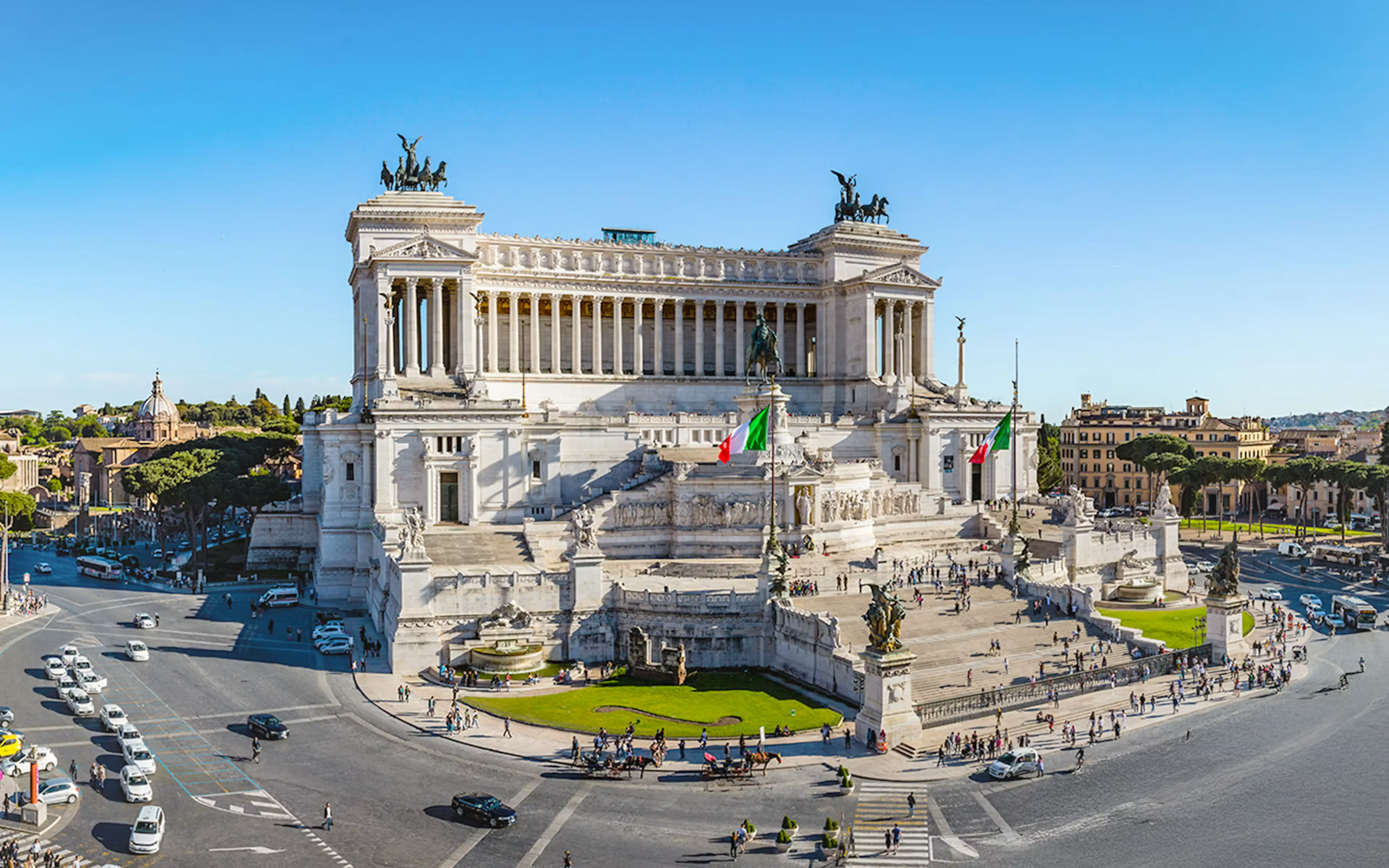
The panoramic terrace is the Vittoriano's most advertised experience, but going straight to the lift reduces a complex monument to a viewing platform. These ten highlights form a route from Piazza Venezia to the summit and explain what makes each stop more than a photo opportunity.
1. The full façade from Piazza Venezia
Begin far enough back to see the composition safely from the pedestrian edge. The lower fountains, converging stairs, central altar, equestrian statue and upper colonnade form one deliberate ascent. This is the only viewpoint from which Sacconi's enormous symmetry can be understood at once.
2. The two sea fountains
At the lower sides, Emilio Quadrelli's Adriatic fountain and Pietro Canonica's Tyrrhenian fountain establish Italy's geography before the route reaches regions and cities. Their lateral position also shows how widely the monument spreads across the Capitoline slope.
3. The Altar of the Fatherland
Angelo Zanelli's altar is the sculptural and ceremonial centre. The personification of Roma sits against a luminous ground, flanked by long relief compositions. The name Altare della Patria correctly refers to this element, though it is often applied to the whole Vittoriano.
4. The Tomb of the Unknown Soldier
Installed in 1921, the tomb changed the building from a royal memorial into a national place of mourning. Eternal flames and an honour guard mark the grave. Pause quietly, avoid obstructing ceremonial space and remember that this remains a working shrine.
5. The first-balustrade value groups
Four large sculptures represent Strength, Concord, Sacrifice and Right. Look for the modern worker paired with military history in Strength, the family within Concord, the dying soldier of Sacrifice and defeated Tyranny beneath Right. They make abstract state ideals visible through human bodies.
6. Victor Emmanuel II on horseback
The bronze king is much larger than he appears from the square. Enrico Chiaradia designed it and Emilio Gallori completed it; Giuseppe Maccagnani's base carries fourteen historic-city allegories. Walk to one side to appreciate the horse's volume and the figures around the pedestal.
7. The regional allegories
Figures above the upper portico represent Italy's historical regions. They should not be treated as a perfect map of today's administrative system; they preserve the geography imagined when the monument was created. Together they express unity as an arrangement of local identities.
8. The Central Museum of the Risorgimento
The museum is the intellectual counterpart to the façade. Documents, letters, paintings, weapons, flags and personal relics trace the movement for Italian independence and unification from the eighteenth century through the First World War. It also introduces protagonists beyond the king, including Mazzini and Garibaldi.
9. The Sommoportico and quadrigae
The great upper colonnade provides the architectural climax. At its ends, bronze quadrigae commemorate Unity and Freedom. From below they are dark silhouettes; near the summit, the horses and winged charioteers reveal their monumental scale.
10. The Panoramic Terrace
Glass lifts rise to a 360-degree viewpoint about 70 metres above the city. The nearest landmarks are especially clear: the Roman Forum and Imperial Fora, Capitoline Hill, Santa Maria in Aracoeli and Trajan's Column. Farther away, find the Colosseum, domes of the historic centre and St Peter's.
Turning the list into a visit
Allow 30–45 minutes for the free exterior highlights and at least another hour for the museum. The rooftop adds roughly 30–45 minutes depending on lift waits and how long you spend identifying landmarks. A balanced visit is therefore closer to two hours than a quick photograph from the stairs.
Current VIVE arrangements make the exterior memorial free, while the Panoramic Terrace, Sommoportico, Central Museum and Palazzo Venezia use a combined paid ticket. Hours, prices and routes can change, so check the official site before arrival.
Prioritize the highlights by interest
Visitors interested in remembrance should give most attention to the altar, Unknown Soldier and the relationship between tomb, Roma and equestrian king. The essential museum follow-up is the First World War end of the Risorgimento route, which explains how national unification and wartime sacrifice were connected in twentieth-century memory.
Architecture-focused visitors should spend longer at the sides. From there, the terraces reveal depth hidden by the frontal photograph, and the meeting between the Vittoriano, Aracoeli and Capitoline becomes easier to understand. The Sommoportico's sixteen columns, each about 15 metres high, deserve close attention before the panoramic lift.
Art-focused visitors can build a sequence from the Quadrelli and Canonica sea fountains to the four value groups, Maccagnani's fourteen city allegories, Zanelli's altar, the sixteen regions and the Fontana and Bartolini quadrigae. This route demonstrates how many artists worked inside Sacconi's framework.
Three details worth binocular-free close looking
First, find the modern worker leaning on a pickaxe in Rivalta's Strength. He shares the group with a medieval soldier, linking civil and military energy across time. Second, compare the movement of Bistolfi's dying soldier in Sacrifice with the controlled pose of Victor Emmanuel II. Third, inspect the quadrigae from the summit, where their construction becomes clearer than from the square.
Do not attempt to identify every regional attribute from street level. Distance and angle make confident claims unreliable. Official labels and the paid upper route offer better evidence than extreme camera zoom.
If lifts, weather or time change the plan
The viewpoint is only one of ten highlights. If wind or operational needs affect the summit, the altar, memorial, first-balustrade sculpture and museum can still form a complete visit. If the museum is the unavailable element, use the free exterior slowly and retain the combined ticket for Palazzo Venezia or a return within its current seven-day validity.
Visitors with 45 minutes should choose the free memorial and first sculpture levels. With 90 minutes, add either the museum or roof. With two hours, the full sequence becomes realistic. These priorities are more resilient than a checklist that fails as soon as one queue appears.
One final detail to notice
At every upper level, look back. Sacconi designed the route so that the monument gradually releases the city into view. The shift from façade to panorama is itself a highlight: Rome moves from background to the principal subject, and the Vittoriano becomes a platform for understanding the capital it was built to transform.
Yazar hakkında

Rome Visitor Guide
Bu bağımsız rehber, ziyaretçilerin ücretsiz giriş ile biletli deneyimleri ayırt edebilmesine yardımcı olmak amacıyla VIVE, İtalya Kültür Bakanlığı ve müze bilgilerinden derlenmiştir.
Tags
Comments (0)
Loading comments...